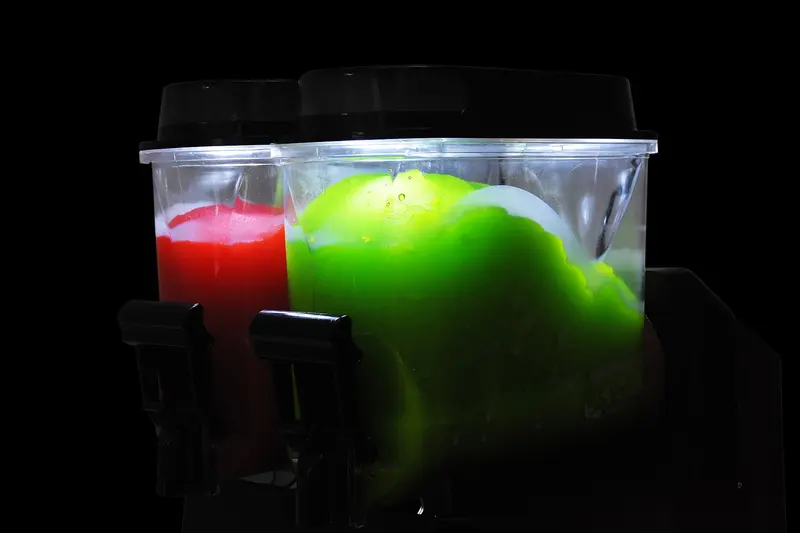
Slush is ice crystals swimming in syrup
A good slush is a soft mush of very small ice crystals surrounded by liquid that hasn’t frozen. The liquid part is a concentrated syrup, which is why slush stays scoopable instead of setting into a block like an ice lolly.
Inside a home slush machine
Compressor machines such as the Ninja SLUSHi and Tower Slushie Fusion work like a small fridge built into the base. Ninja describes it like this: your drink is rotated around a chilling cylinder, which it calls the evaporator, to keep it at the right temperature and texture. A spiral auger keeps the drink moving, so ice forms as small crystals that stay suspended rather than one solid lump. Tower describes the same idea as liquid swirling 360° around an icy cold chamber.
Because the cold comes from the machine, there is no ice to add and nothing to water the drink down.
Why sugar matters
Dissolved sugar lowers the temperature at which water freezes. Chemists call this freezing-point depression: the sugar gets in the way of water molecules locking together into ice. In a slush machine that means:
- Enough sugar: some water freezes into fine crystals while the rest stays as syrup — slush.
- Too little sugar: too much of the water freezes and the crystals knit together. Ninja puts it simply: “Too little sugar will prevent proper freezing of a slush output.”
That is why the makers set minimums. Ninja says all inputs must contain at least 4% sugar; Tower recommends a minimum of 5% for its Slushie Fusion and says not to use diet or zero/low-sugar drinks.
Reading the label
On a UK nutrition panel, “of which sugars” per 100 ml tells you roughly the sugar percentage of a thin drink: 4 g per 100 ml is about 4%. Mixing drinks changes it, so use our calculator to work out the sugar level of a whole batch.
What is Brix?
Degrees Brix (°Brix) is a measure of sugar in a liquid: 1 °Brix is 1 gram of sucrose in 100 grams of solution. Drinks makers measure it with a refractometer. For a sugar-and-water drink, °Brix is close to the sugar percentage, so a 10 °Brix mix is roughly a 10% sugar mix.
Why alcohol stops drinks freezing
Alcohol (ethanol) freezes at about −114 °C, far colder than water. Mixed with water it lowers the freezing point — gram for gram far more than sugar does — which is why a bottle of vodka doesn’t freeze in a home freezer. In a slush machine:
- A little alcohol gives a softer slush — fine.
- Too much and the mix won’t freeze at the temperatures the machine can reach. Ninja says “Too much alcohol will prevent proper freezing of a slush output.”
So the makers set limits for the whole mix, not for the bottle: Ninja’s original SLUSHi takes pre-mixed drinks between 2.8% and 16% ABV on its cocktail setting, and its XL, MAX and Twist go up to 20%. Spirits at 37.5–40% always need diluting. See frozen cocktails and vodka slushies for the maths.
What commercial slush does differently
Shop slush machines often use syrups containing glycerol (E422) to keep the slush texture with less sugar. The Food Standards Agency advises that children under seven should not have slush drinks containing glycerol — see our safety guide. Home machines don’t need it.
A worked example
1,500 ml of lemonade with 5 g of sugars per 100 ml contains 75 g of sugar. Add 200 ml of 37.5% vodka and you have 1,700 ml containing 75 g of sugar — about 4.4% sugar, just over Ninja’s 4% line. The vodka diluted it. The same batch is about 4.4% ABV (75 ml of pure alcohol in 1,700 ml) and contains 7.5 UK units.